Integration is a B

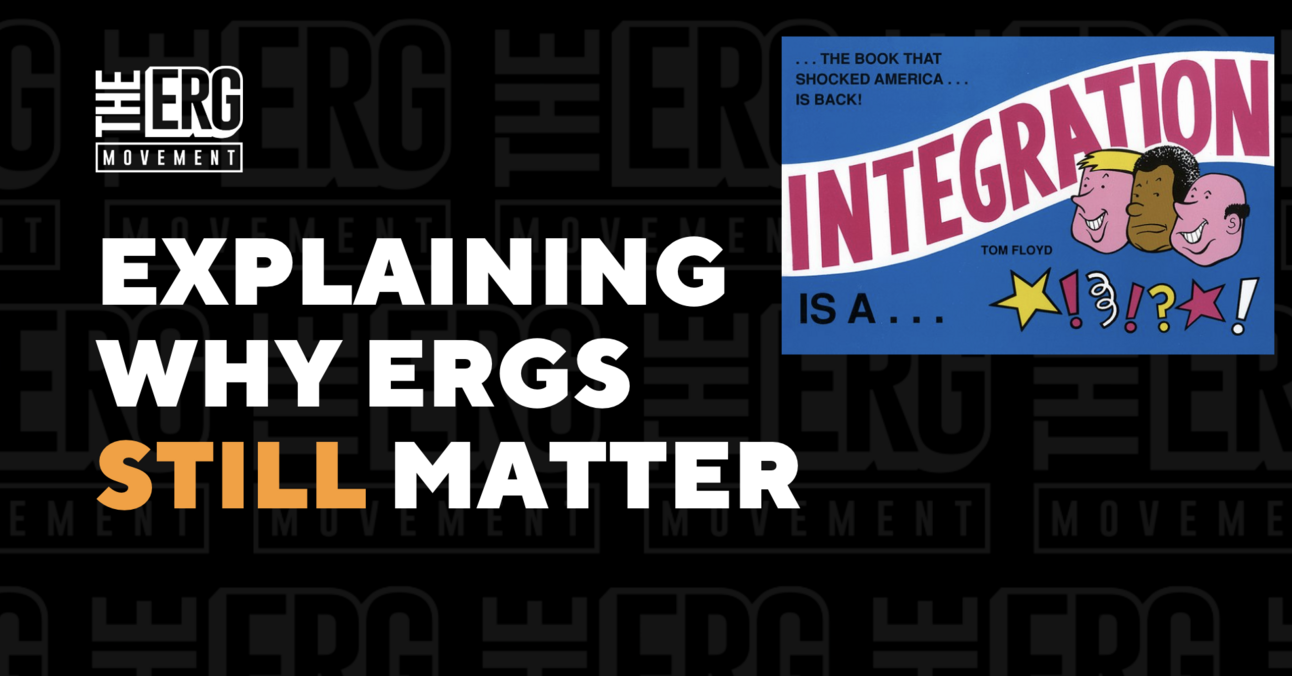
A 60-year-old book from a yard sale sparked a reflection on how little has changed in workplace integration. In this issue, The ERG Homegirl unpacks what “incomplete integration” means today, why ERGs still matter, and how performative inclusion misses the point. From Mr. Brown in the ’60s to modern
Hey Champs 🏆
Today's newsletter is basically a transcript of a rambling from this weekend. I call these "car thoughts." For those who'd rather read than listen, this summary captures the gist.
The book that sparked this
This weekend I saw an interesting post on Twitter: someone shared a book they found at a yard sale, "Integration is a B****." It's told mostly through insightful cartoons that paint a picture of what integration was like for Black folks in the workplace in the 1960s.
The 60s were also when ERGs were first started in the workplace, so reading the book through that lens really adds some color to the experiences of the ERG pioneers. The kicker? It's not that far off from where we are now.
My hot take: integration was never finished
Reading this book, almost 60 years after its publication, and seeing experiences I or people I know have faced today, really speaks to one of my latest hot takes:
Integration in the workplace never fully completed.
We brought more Black people and people from diverse backgrounds into corporate spaces, but the culture of corporate America is still very much a work in progress.
Think about it: 60 years later, we're still passing laws like the CROWN Act to prevent hair discrimination. Hair! Something that shouldn't matter at all, but historically wasn't considered "professional." That alone tells you the integration process was incomplete. Why did we stop or slow down? It feels like we're still in the early stages of true integration.
Which brings me to ERGs
I've always been a big advocate for ERGs for underrepresented people because integration hasn't fully happened. People still seek community with others who understand their experience inside a corporate culture rooted in the past. Back in the 50s and 60s, being your true self at work was met with sideways glances. It's more subtle now, but it's still there.
Highlights from the book that still happen today
- A Black employee whispering to Mr. Brown: "I'm so glad you're here."
- Mr. Brown being congratulated by white colleagues in a performative way — "See, here's proof that you guys can make it." Tokenism is alive and kicking.
- Mr. Brown being "complimented" with: "Great idea, who helped you with it?" Contributions from marginalized groups are often credited elsewhere.
- Mr. Brown being asked to do basic tasks outside his role scope. Been there.
- Mr. Brown being asked, on a company-wide channel, "What do you think about Negroes in the streets? I mean, crime in the streets." This mirrors today's uncomfortable racial questions in workplace settings.
- A white employee explaining something basic to Mr. Brown when he clearly already knows the information. The look on the employee's face says it all.
- Mr. Brown being paraded around the office for a photo op: "Make sure these pictures are sent to the Black dispatch, Afro American news, etc." Performative diversity, anyone?
Why this matters for ERGs
The book is called "Integration is a B****," and honestly, I still agree with that sentiment today. That's more squarely DEIB work — and there are people who know way more on that than I do. But I rarely, if ever, hear the DEI conversation framed from the angle of integration.
Just because we're 60 years down the road doesn't mean integration has been completed. There's more to it than getting diverse people into the workplace (desegregation). Real integration is about changing mindsets and fostering a culture where even microaggressions are called out. That's not my lane — and frankly, I can't say I've ever seen it fully happen.
My lane is creating spaces for people to help make the experience of existing in a non-integrated workplace a little better. That's what ERGs are for me. That's why community is enough.
A question to sit with
It feels disrespectful to the original cause when we lose sight of that. If the founders of the first ERG saw what ERGs have become today, would they recognize their vision?
Can you imagine if the pioneers of ERGs were told they had to:
- Make money for the company
- Come up with marketable ideas
- Be spotlighted as having "the best experience ever"
Almost certainly, they would have denied it — and rightfully so.
My goal is to make it clear how important this is. There's work to be done.
Let's keep making waves, Champs.